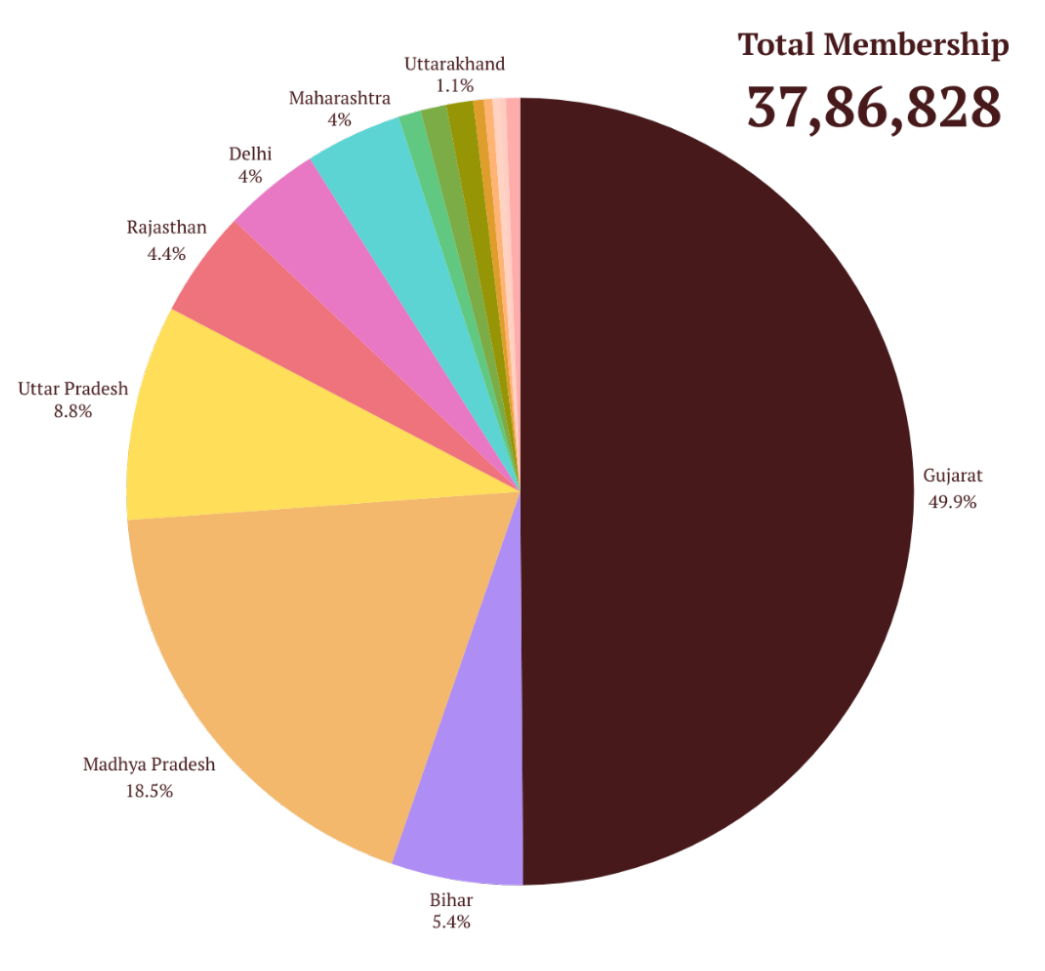
Impact at SEWA Cooperative Federation is reflected in cooperative institutions that continue to function viably, leadership that evolves, and their businesses that adapt with changing conditions. At the core, these cooperatives are formed by the members of SEWA Union – the single largest women worker’s Central trade union in India.
*These numbers indicate reach, not the full depth of change.
Some of the strongest indicators of impact are cooperatives that continue over time. In certain cases, this includes institutions that have been revived after periods of difficulty. In others, it is reflected in new leadership emerging within existing structures.
SEWA Bank, SEWA’s first cooperative, was set up to make credit accessible for women in the informal economy.
Abodana Handicrafts Cooperative, a women artisans' cooperative was established.
Saundarya Safai Cooperative, the first cleaning cooperative for women in Gujarat was set up.
Lok Swasthya Health Cooperative was set up to ensure quality healthcare for women in the informal economy.
Pethapur Milk Cooperative, the first women's milk cooperative in Gujarat was established.
Gujarat State Women’s SEWA Cooperative Federation was set up as a support system for informal women workers’ cooperatives. The first of its kind in India
Acquired membership in the National Cooperative Union of India (NCUI).
Vegetable Shop No. 40, Ahmedabad's first women owned and run vegetable shop was set up in the APMC.
Rachaita Construction Cooperative, the first cooperative for women workers in a male-dominated space, was set up.
SEWA Homecare Cooperative, first cooperative for domestic workers in Gujarat was established.
The International Labour Organization (ILO) conducted a comprehensive research of 12 cooperatives affiliated with SEWA Federation.
We were listed among the Top 50 COVID responders in India by the World Economic Forum.
Representation on the CICOPA Board, first for an Indian organization.
We were selected as gifting partners for ICA (New Delhi) conference, first time held in India.
Held National Conference of Women Cooperators from 10 states with VAMNICOM.
Leadership evolves within cooperatives through experience, mentoring, and shared responsibility.
This includes supporting board members in governance roles, as well as creating pathways for younger women to participate and take on leadership.
Women’s cooperatives operate in environments shaped by disruption – whether from market shifts, climate stress, or events such as the COVID-19 pandemic.
Responses differ across sectors, but the focus remains on sustaining work and protecting livelihoods without fragmenting collective structures.
The Federation also engages with institutions and policy spaces that shape how cooperatives function.
This includes contributing to research, participating in forums, and developing policy briefs grounded in cooperative experience.
Much of this work is documented through reports, studies, and reflections.